Pack a tent designed for dry climates into the Coast Mountains of British Columbia, and it will likely leak by night two. That’s the starting point for gear selection near Vancouver BC — not a general camping checklist, but a specific answer to what the Pacific Northwest climate actually does to gear, and to campers who didn’t prepare for it.
The area within two hours of Vancouver includes Garibaldi Provincial Park, Golden Ears, Manning Park, and the Stein Valley. All share the same wet, variable conditions. This guide covers what to prioritize, where to spend, and what most people buy that turns out to be the wrong call.
What the Pacific Northwest Climate Actually Does to Your Gear
Vancouver BC sits in a temperate rainforest zone. The city receives roughly 1,150mm of rain per year, but that number is misleading — rainfall concentrates heavily in fall and spring, and the Coast Mountains receive significantly more. Understanding these patterns shapes every gear decision you’ll make.
Rain Isn’t Just Precipitation — It’s Constant Ambient Moisture
Pacific Northwest rain isn’t a hard downpour that stops and lets things dry. It’s often fine, persistent, and horizontal in wind. Trails stay wet for days after rain events. Fog deposits moisture on tent fly material overnight. Ground moisture seeps upward through tent floors. Your gear isn’t just exposed to rain — it spends time in a saturated environment for hours at a stretch.
The practical consequence: anything rated water-resistant rather than waterproof will fail. Water-resistant fabrics repel light splash but absorb water under sustained pressure or extended contact. Waterproof fabrics with taped seams don’t. For sleeping bags, stuff sacks, and backpack covers, water-resistant is a liability out here, not a feature.
Temperature Variability Is the Bigger Problem Than Cold
The Coast Mountains above Vancouver see dramatic daily temperature swings. July daytime highs at backcountry sites like Russet Lake in Garibaldi regularly reach 22°C to 26°C. The same nights drop to 5°C or lower. After a weather front passes through — which happens multiple times per week — overnight temps at 1,500m elevation can reach 2°C to 3°C even in July.
Most gear selection mistakes happen here. Hikers pack for the forecast high and find themselves cold by 2am. A sleeping bag rated to 10°C comfort is technically a summer bag and will leave a cold sleeper miserable at 5°C. The margin for error on the Coast is smaller than in continental climates because the temperature floor is unpredictable in a way that dry-climate mountain areas simply aren’t.
Down vs. Synthetic Insulation in a Wet Climate
Down insulation — in sleeping bags and puffy jackets — loses most of its warmth when wet. Synthetic fill retains around 80% of its insulation value when damp or compressed by overnight condensation. For car camping where your gear stays dry in the trunk until camp is set up, down’s packability and warmth-to-weight advantage is real. For multi-day backpacking in shoulder season, or any trip where you’ll be in sustained rain on-trail, synthetic is the more reliable choice.
This isn’t brand preference — it’s about the risk profile of the specific trip you’re taking. A dry July weekend at Cheakamus Lake is a different risk calculation than a five-day October traverse of the Stein.
The Gear Decision That Determines Everything Else
Buy a legitimate hardshell rain jacket before anything else on this list. Not a softshell. Not a 2-layer DWR-coated jacket. A hardshell with taped seams.
The $60–100 waterproof jackets at department stores use polyurethane coating rather than a proper membrane, and they delaminate after 10–15 washes. After two Vancouver weekend trips, the shoulder seams and cuffs wet through entirely. The $140–180 mid-tier jackets sit in a genuinely bad position: not cheap enough to treat as disposable, not durable enough to count on in sustained Coast Mountain rain.
The Arc’teryx Beta AR jacket (~$900 CAD) is the benchmark for frequent campers — Gore-Tex Pro, fully taped seams, built to last a decade of regular use. The MEC Rain Shadow jacket (~$200 CAD) is the entry point that actually works: 2.5-layer construction, taped critical seams, two to three seasons of reliable performance before degradation. The Patagonia Torrentshell 3L (~$320 CAD) justifies the premium over the MEC option if you camp more than six times a year and want better breathability without paying Arc’teryx prices.
Skip the mid-tier entirely. Buy cheap and replace it, or buy quality once.
Essential Vancouver BC Camping Gear, Ranked by What Fails First
Pacific Northwest conditions expose gear failures in a specific order. Tents leak first, sleeping systems fail when temperatures drop unexpectedly, then stoves sputter in wind. Ranking by failure order tells you where to spend and where the budget option genuinely holds up.
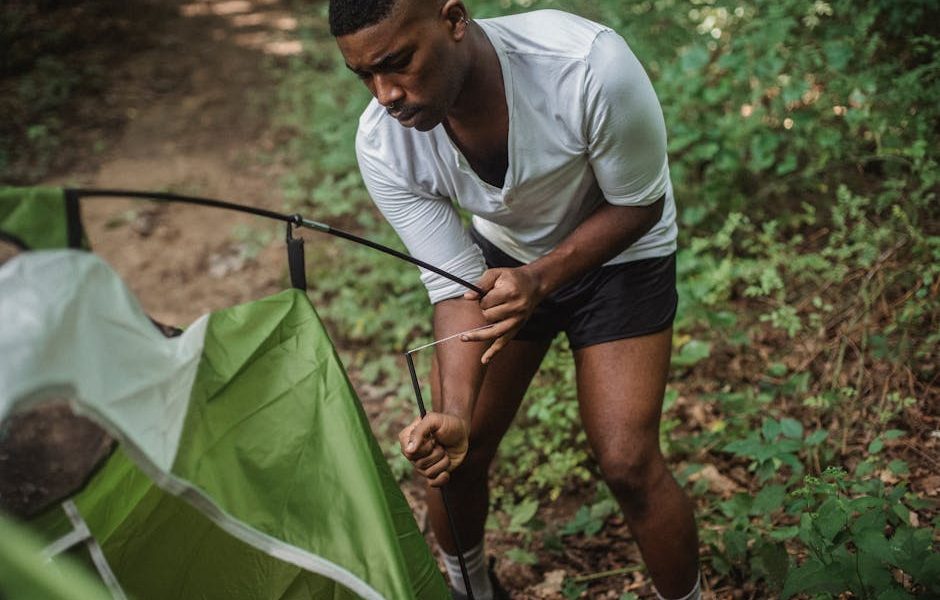
- Tent with factory-taped seams. Waterproofing ratings in mm hydrostatic head only matter if the seams don’t fail first. A 3,000mm fly with un-taped seams loses to a 1,500mm fly with factory seam tape every time in sustained rain. The Hilleberg Nallo 2 (~$1,100 CAD) is the most reliable two-person option for serious BC backcountry use. The MSR Elixir 2 (~$350 CAD) is the budget floor — factory-taped seams, three-season competence, and it handles the Lower Mainland adequately. Avoid any tent that ships with a tube of seam sealer and expects you to do the job yourself.
- Sleeping bag rated to 0°C or lower. The Sea to Summit Spark III (rated −6°C limit, 480g, ~$380 CAD) is light enough for backpacking and handles genuine cold nights at elevation. The MEC Mirage 0 Synthetic (~$280 CAD) is the wet-climate pick — synthetic fill, 0°C comfort rating, and it won’t lose meaningful warmth if tent condensation settles on the bag overnight.
- Sleeping pad with R-value 4.0 or higher. Ground cold in the Coast Mountains pulls heat away faster than air temperature does. The Thermarest NeoAir XLite NXT (~$280 CAD, R-value 4.5) is the backpacking standard. For car camping, the Thermarest MondoKing 3D (~$180 CAD) delivers near-mattress comfort at half the backpacking pad price. Foam pads top out around R-value 2.0 — inadequate for Coast Mountain ground conditions. Upgrading from foam to an inflatable pad produces more warmth gain per dollar than most sleeping bag upgrades will.
- Wind-capable stove. The MSR PocketRocket 2 (~$55 CAD) is the best-value backpacking stove for sheltered forest sites. In exposed ridge camps or coastal sites with consistent wind, the Jetboil Flash (~$150 CAD) wins because of its integrated windscreen and sealed burner. Most Lower Mainland car camping sites are sheltered enough that the PocketRocket 2 handles it fine.
- Waterproof dry bags for sleeping bag and electronics. Even with a good tent, condensation and unexpected rain exposure can wet critical gear. Sea to Summit Ultra-Sil dry bags (~$20–35 CAD each) are the fix. Keep the sleeping bag in one from the moment you leave the car — not just when it’s actively raining.
- Bear canister for backcountry sites. Black bears are active across Garibaldi, Golden Ears, and Manning Park. BC Parks recommends certified canisters at designated backcountry sites, and enforcement has increased at popular zones like the Garibaldi Lake area. The BearVault BV500 (~$100 USD) holds two to three nights of food for one person and fits in most 65L packs without major reorganization.
Two tips that apply regardless of brand or budget: waterproof your boots before the trip, not after the first wet day when the damage is already done. And bring trekking poles — wet root networks and rain-slick rock slabs on PNW trails make ankle stability a real concern, not optional comfort equipment.
Price Point Comparison: Where the Tiers Actually Matter
Some gear categories show significant performance jumps between budget and mid-range options. Others are nearly indistinguishable. Here’s how the price-to-performance curve actually looks for Vancouver BC camping conditions:
| Gear Category | Budget | Mid-Range | Premium | Best Value Tier |
|---|---|---|---|---|
| Tent (2-person) | MSR Elixir 2 (~$350 CAD) | Big Agnes Copper Spur HV UL2 (~$650 CAD) | Hilleberg Nallo 2 (~$1,100 CAD) | Mid-range unless doing serious alpine routes |
| Rain Jacket | MEC Rain Shadow (~$200 CAD) | Patagonia Torrentshell 3L (~$320 CAD) | Arc’teryx Beta AR (~$900 CAD) | Skip the $140–180 tier entirely |
| Sleeping Bag (3-season) | MEC Mirage 0 Synthetic (~$280 CAD) | Sea to Summit Spark III (~$380 CAD) | Western Mountaineering AlpinLite (~$650 CAD) | Mid-range is the sweet spot |
| Sleeping Pad | Thermarest Z Lite Sol (~$65 CAD, foam, R-2.0) | Thermarest NeoAir XLite NXT (~$280 CAD, R-4.5) | Thermarest NeoAir XTherm (~$350 CAD, R-7.3) | Upgrade from foam — worth it here |
| Stove | MSR PocketRocket 2 (~$55 CAD) | Jetboil Flash (~$150 CAD) | MSR Reactor (~$280 CAD) | Budget wins for most sheltered Lower Mainland sites |
| Pack (65L) | MEC Camino 65 (~$160 CAD) | Osprey Atmos AG 65 (~$370 CAD) | Arc’teryx Bora 65 (~$600 CAD) | Mid-range — hip suspension matters on wet, uneven terrain |
MEC’s flagship store on West Broadway in Vancouver carries most of these categories in-person, which matters for big purchases. You can check seam taping quality, zipper action, and sleeping bag loft before committing. For smaller items — fuel canisters, dry bags, headlamps — price differences between in-store and online are small enough that convenience wins.
The rain jacket category breaks the general rule that mid-range is good enough. The $140–180 bracket is the worst place to spend money on rain gear for Vancouver conditions. Buy at the bottom or the top.
Three Gear Mistakes That End Vancouver BC Camping Trips Early
Buying a tent that ships with seam sealer instead of sealed seams
Many tents labelled three-season ship without factory-taped seams, expecting users to apply seam sealer before the first trip. In dry climates, skipping this step isn’t immediately catastrophic. In the Coast Mountains, un-taped seams let water through within hours of sustained rain. Before buying any tent, confirm the spec sheet says factory seam taped or factory seam sealed. If it says seam sealing included — that means a tube of sealant ships in the box and the job is yours. That’s not a sealed tent.
Packing for the forecast high instead of the overnight low at elevation
October camping near Vancouver is not summer camping with a jacket added. Trails to Garibaldi Lake, Black Tusk, and Panorama Ridge receive snowfall in September and October. Overnight lows at Garibaldi Lake (1,472m elevation) can reach −5°C in late September. A setup built for July highs — a 10°C sleeping bag, a minimal single-wall tent, trail runners — is genuinely dangerous in those conditions, not just uncomfortable.
The forecast high is the least useful number in Pacific Northwest trip planning. The overnight low at your camp elevation is what your gear list needs to answer.
Upgrading the sleeping bag while keeping the foam pad
Ground insulation accounts for roughly 30% of total sleeping warmth. Cold ground pulls heat away from a sleeping bag faster than cold air does. A high-quality bag on a foam pad with R-value 2.0 will leave you cold even on mild nights, because the insulation beneath you is failing — not the bag on top. The upgrade from a foam pad to the Thermarest NeoAir XLite NXT produces a larger warmth improvement per dollar than most sleeping bag upgrades do. Most people learn this on their third cold night, not their first.
The gear that gets overlooked most often is the gear under you, not on top of you.